
In industrial cooling and heat transfer systems, one common question appears during project planning:
Should we use a Fin & Tube Heat Exchanger or a Shell & Tube Heat Exchanger?
Both are proven technologies. Both can deliver excellent performance. But they are designed for very different operating environments.
Choosing the wrong type can create unnecessary cost, lower efficiency, space issues, maintenance burden, or weak lifecycle value.
Choosing the right type creates operational confidence.
This guide explains the real difference between a fin and tube heat exchanger vs shell and tube heat exchanger so buyers, consultants, engineers, and procurement teams can make better decisions.
Understanding the Core Difference
Fin & Tube Heat Exchanger
A Fin & Tube Heat Exchanger uses tubes carrying fluid, surrounded by fins that increase surface area. Air passes across the fins to absorb or reject heat.
This design is ideal when air-side heat transfer is required.
Common examples:
- HVAC cooling coils
- Condenser coils
- DX coils
- Chilled water coils
- Dry coolers
- Refrigeration evaporators
Shell & Tube Heat Exchanger
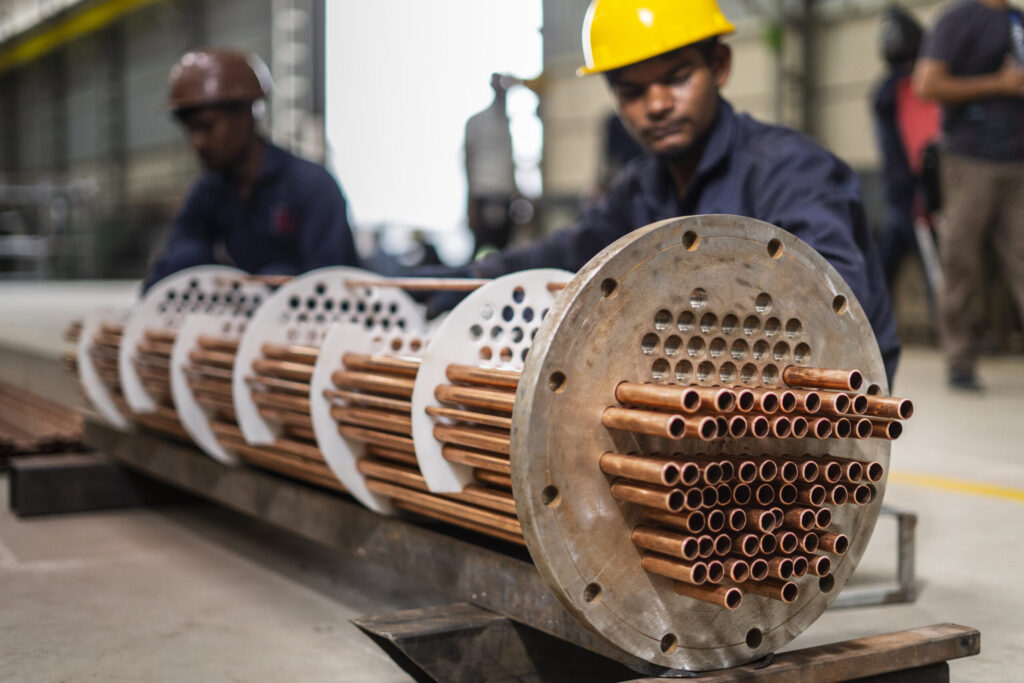
A Shell & Tube Heat Exchanger contains tubes enclosed inside a shell. One fluid flows through the tubes, another through the shell side.
This design is ideal for fluid-to-fluid heat transfer under industrial duty.
Common examples:
- Oil coolers
- Process coolers
- Condensers
- Evaporators
- Utility exchangers
- Compressor cooling
Quick Comparison Table
| Factor | Fin & Tube | Shell & Tube |
| Main Transfer Medium | Air to fluid | Fluid to fluid |
| Common Industries | HVAC, refrigeration | Process industry, utilities |
| Pressure Handling | Moderate | High |
| Temperature Severity | Moderate | High |
| Space Efficiency | Compact | Larger footprint |
| Cleaning Complexity | Air-side accessible | Internal cleaning required |
| Heavy Industrial Duty | Limited by design | Excellent |
| Custom Process Applications | Good | Excellent |
When Fin & Tube Heat Exchangers Are the Better Choice
Choose a fin tube heat exchanger manufacturer when your application involves airflow and compact cooling requirements.
Ideal for:
- Air Handling Units (AHU)
- Industrial HVAC systems
- Clean rooms
- Chillers
- Cold rooms
- Refrigeration plants
- Dry cooler systems
- Commercial cooling
Why It Wins Here
- Large air-side surface area
- Faster response in airflow systems
- Compact footprint
- Good for temperature-controlled spaces
- Efficient for HVAC loads
When Shell & Tube Heat Exchangers Are the Better Choice
Choose a shell and tube heat exchanger manufacturer when your application involves process fluids, pressure, durability, and rugged industrial duty.
Ideal for:
- Chemical plants
- Pharma utilities
- Oil & gas systems
- Steel plants
- Power plants
- Hydraulic oil cooling
- Compressor systems
- Process heating/cooling
Why It Wins Here
- Strong pressure handling
- Better for dirty fluids
- Robust mechanical construction
- Long industrial service life
- Suitable for demanding continuous operation
What Many Buyers Get Wrong
Some buyers compare only:
- External dimensions
- Price
- Delivery time
That is risky.
Real industrial heat exchanger comparison should evaluate:
- Thermal duty
- Pressure drop limits
- Maintenance access
- Fluid properties
- Fouling risk
- Corrosion environment
- Lifecycle cost
- Space constraints
- Shutdown impact
Engineering suitability matters more than catalogue comparison.
HVAC Coil vs Shell Tube Exchanger: Common Mistake
In HVAC environments, some teams consider shell & tube units where airflow coils are needed.
In process plants, some teams try using coil-style solutions where rugged fluid duty exists.
This mismatch creates:
- Lower efficiency
- Wrong footprint
- Higher maintenance
- Poor lifecycle economics
Correct selection starts with application understanding.
Which Is Better for Maintenance?
Fin & Tube
Best when:
- Air filters are maintained
- Coil cleaning access exists
- Indoor controlled environments exist
Shell & Tube
Best when:
- Heavy-duty maintenance teams exist
- Mechanical cleaning is planned
- Dirty fluids require stronger construction
Neither is universally better. Each suits different maintenance realities.
Which Is Better for Energy Efficiency?
Both can be efficient when correctly selected.
Efficiency depends on:
- Correct sizing
- Proper design surface area
- Good flow management
- Clean surfaces
- Real operating match
Wrong selection creates inefficiency, regardless of product type.
Should You Choose Standard or Custom Design?
For serious operations, custom heat exchanger selection often creates better results than standard catalogue buying.
Custom engineering helps with:
- Existing footprint fitment
- Higher load demands
- Corrosive media
- Pressure constraints
- Retrofit projects
- Utility optimization
How Serious Buyers Decide
Professional buyers usually ask:
- What medium are we cooling or heating?
- Is heat transfer air-side or fluid-side?
- What is the operating pressure?
- What are maintenance realities?
- Is this new project or replacement?
- What is lifecycle cost, not only purchase cost?
That decision framework prevents expensive mistakes.
Why Buyers Choose Omeel Coils
Omeel Coils supports industries with both Fin & Tube Heat Exchangers and Shell & Tube Heat Exchangers, allowing solution recommendations based on real operating conditions rather than forced product bias.
Our strengths include:
- Application-based engineering
- HVAC and process understanding
- Custom manufacturing capability
- Replacement support mindset
- Quality-led execution
- Serious industrial delivery focus
Final Thoughts
The question is not whether Fin & Tube or Shell & Tube is better.
The real question is:
Which one is right for your application?
When selection aligns with duty conditions, both technologies can deliver excellent results.
When selection is driven only by price or assumption, problems begin later.