
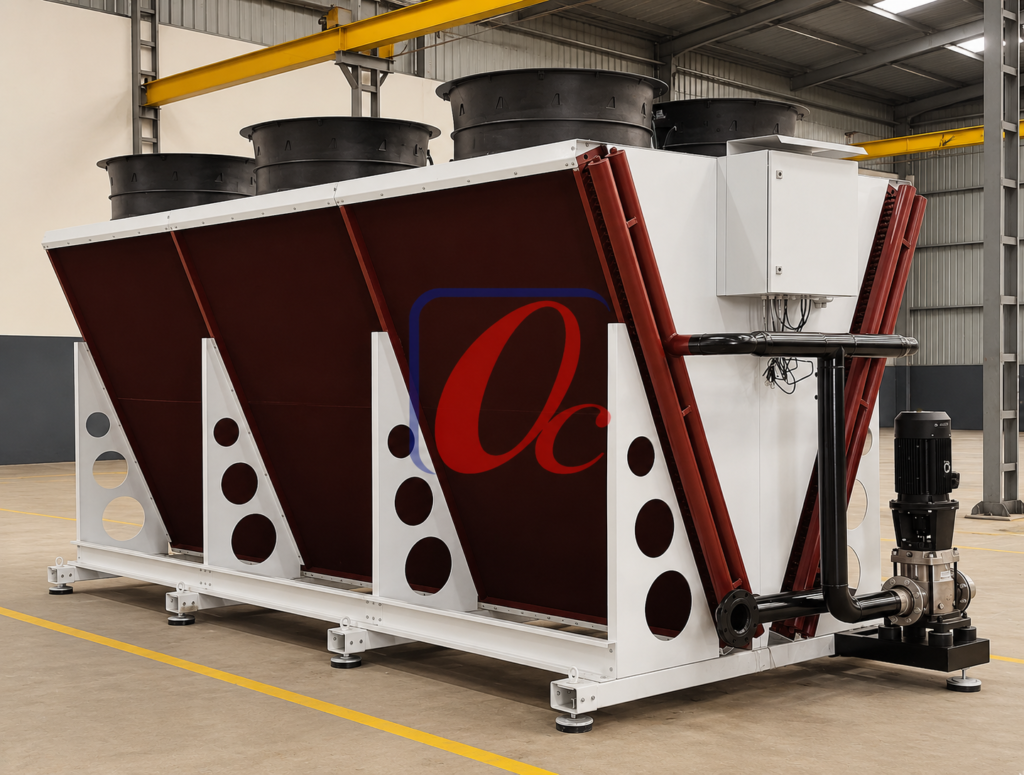
For decades, cooling towers have been a common solution for industrial heat rejection.
But the modern industry is changing.
Water costs are rising. Environmental pressure is increasing. Maintenance teams are stretched. Plants want cleaner systems, lower risk, and predictable operating cost.
That is why many buyers now compare dry coolers vs cooling towers before making capital decisions.
The truth is simple:
Neither system is universally better. The right choice depends on your operating priorities.
This guide explains the real engineering and commercial differences so serious buyers can decide intelligently.
Understanding the Core Difference
What Is a Cooling Tower?
A cooling tower rejects heat through evaporative cooling.
Warm water from process equipment is circulated through the tower. Air movement and evaporation remove heat, and cooled water returns to the system.
Cooling towers are effective where water is available and low approach temperatures are needed.
What Is a Dry Cooler?
A Dry Cooler transfers heat through finned coils using fan-driven ambient air.
The process fluid remains in a closed loop. Heat is rejected to air without evaporating water.
This makes it a cleaner and increasingly popular cooling tower alternative for many modern plants.
Quick Comparison Table
| Factor | Dry Cooler | Cooling Tower |
| Water Consumption | Very low | High |
| Process Fluid Loop | Closed | Open / recirculating |
| Maintenance | Lower | Higher |
| Water Treatment Need | Minimal | Significant |
| Legionella / Hygiene Risk | Low | Higher management need |
| Initial Cost | Moderate to High | Often Lower |
| Operating Simplicity | High | Moderate |
| Low Temperature Capability | Limited by ambient | Stronger |
| Best For | Clean modern systems | High evaporative performance |
1. Water Consumption Is Now a Strategic Decision
One of the biggest reasons companies explore dry coolers vs cooling towers is water.
Cooling towers consume water through:
- Evaporation
- Drift losses
- Blowdown
- Leakage risk
Dry coolers dramatically reduce water dependence because the system operates through air-side heat rejection.
For water-stressed regions or sustainability-focused businesses, this is a major advantage.
2. Maintenance Reality Matters
Cooling towers often require:
- Water treatment programs
- Basin cleaning
- Scale management
- Biological control
- Fan maintenance
- Drift eliminator checks
Dry coolers generally require:
- Coil cleaning
- Fan inspection
- Electrical checks
- Basic preventive maintenance
For plants with lean maintenance teams, dry coolers often create operational simplicity.
3. Hygiene and Compliance Considerations
Open water systems require disciplined management.
Where hygiene risk, contamination control, or environmental scrutiny matters, closed-loop dry cooler systems become attractive.
This is especially relevant in:
- Pharmaceutical facilities
- Food processing plants
- Sensitive manufacturing environments
- Premium infrastructure projects
4. Efficiency: Which Is Better?
This question requires nuance.
Cooling Towers
Cooling towers can often achieve lower fluid temperatures because evaporative cooling can approach wet bulb conditions.
Dry Coolers
Dry coolers reject heat based on dry bulb ambient temperature, which may limit lowest achievable fluid temperature in extreme climates.
So in some high-load applications, cooling towers may outperform purely on thermal approach.
However, dry cooler vs cooling tower efficiency should not be judged only thermally.
You must also evaluate:
- Water cost
- Chemical treatment cost
- Downtime risk
- Maintenance labour
- Compliance burden
- Lifecycle operating cost
Total efficiency is broader than temperature alone.
5. Lifecycle Cost Often Changes the Decision
A lower purchase price does not always mean lower ownership cost.
Cooling towers may require ongoing spend for:
- Water treatment
- Water replacement
- Cleaning labour
- Shutdown servicing
- Corrosion management
Dry coolers may require higher initial investment, but often lower recurring complexity.
That is why CFOs and plant heads increasingly review lifecycle economics.
6. Where Dry Coolers Are a Better Fit
Choose a dry cooler manufacturer india solution when priorities include:
- Water saving
- Cleaner closed loop systems
- Lower maintenance complexity
- Reliable year-round operation
- Modern plant design
- Utility simplification
- Data centre style cooling philosophy
7. Where Cooling Towers Still Make Sense
Cooling towers may remain practical when:
- Water availability is strong
- Very low process temperatures are critical
- Existing infrastructure already supports towers
- High heat rejection loads favour evaporative systems
- Operations team is experienced in water treatment management
8. Common Buyer Mistakes
Many teams choose based only on:
- Existing habit
- Lowest quotation
- Vendor pressure
- Initial capex only
Better decisions evaluate:
- Site climate
- Water availability
- Utility strategy
- Maintenance manpower
- Expansion plans
- Sustainability targets
- Lifecycle cost
Modern Industry Trend: Cleaner, Simpler, Predictable
Across sectors, many new facilities prefer systems that are:
- Cleaner
- Easier to maintain
- Water conscious
- Lower risk
- Operationally predictable
That trend supports increasing dry cooler demand globally.
Why Buyers Choose Omeel Coils
Omeel Coils supports industrial buyers with engineered Dry Cooler solutions designed around real load conditions, ambient climate, site limitations, and operational priorities.
Our strengths include:
- Application-based engineering
- Custom sizing capability
- Strong coil manufacturing quality
- Industrial reliability mindset
- Technical guidance before purchase
- Serious execution standards
Final Thoughts
The right question is not:
Dry cooler or cooling tower?
The right question is:
What cooling philosophy best supports your plant for the next 10 years?
For many modern industries, the answer is shifting toward cleaner, lower-water, lower-maintenance systems.